Maple Trace Technology · roadside monitoring

Every truck leaves a signature in the road.

MapleTrace MT-16 sits at the side of the road and records how the pavement and the ground beneath it respond: to every heavy vehicle, every hot afternoon and every spring thaw. The data reaches you each morning, without a site visit.

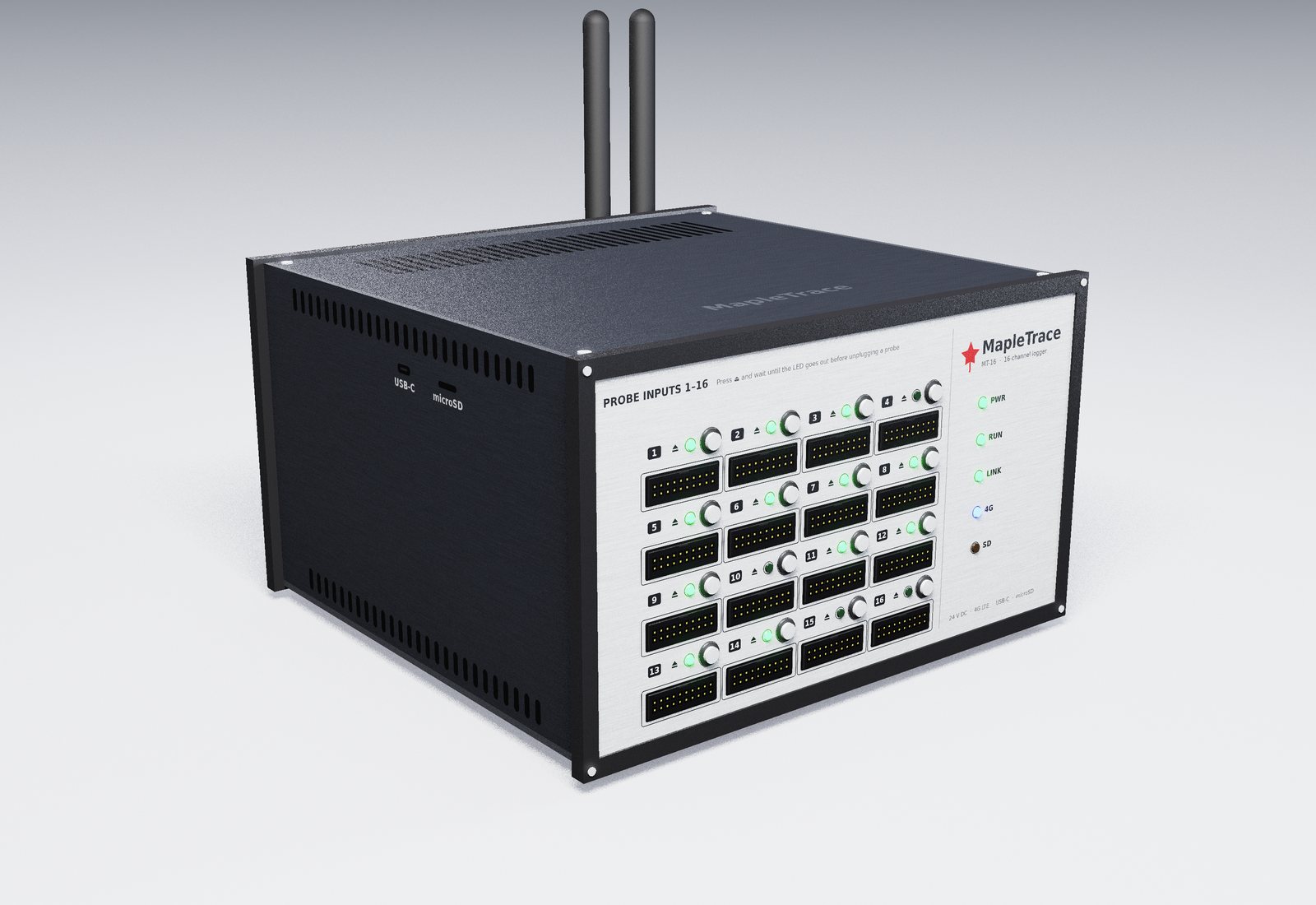
MT-16 roadside logger, front view with sixteen sensor ports and antennas.
06:12:41 · loaded truck, outer wheel path illustrative record
two axles, eight-tenths of a secondµε

Why measure

Roads are designed on paper. They live in the weather.

Design models assume loads and seasons. Real trucks, real frost and real heat are different every year. Measured data turns guesses about a road into decisions.

?

When can spring load limits come off?

Lifting too early damages a thawing road. Lifting too late holds up local freight for weeks.

?

Is the new pavement doing what we paid for?

A new mix or a thinner design only proves itself under traffic, over several seasons.

?

What is the ground really carrying?

Under embankments, culverts and approach slabs, pressure in the soil decides whether settlement starts.

Where it works · example scenarios

Four places an MT‑16 earns its keep

Each scenario uses the same cabinet. What changes is the set of probes you plug in.

Rural truck route · late winter

Lift spring load limits on data, not on the calendar

Each spring the ground thaws from the top down. For a few weeks the base sits wet on frozen soil and the road is at its weakest, so heavy loads are restricted. Most agencies pick the dates from experience.

An MT-16 with a temperature string and strain probes shows the thaw front moving down and the pavement stiffening again, day by day.

The outcomeRestrictions end when the road is ready: not a week too early, not a week too late.
temperature by depthpavement strainair temperature
Read more: Spring load restriction monitoring →
Test sections · two to five years

Compare pavement designs side by side

A recycled-asphalt mix, a thinner overlay, a new concrete joint: the only real test is traffic and seasons. Build two lanes, put identical probes in each, and let the same trucks load both.

Because every port on the MT-16 is sampled on the same clock, a truck crossing both lanes gives a direct, axle-by-axle comparison.

The outcomeEvidence for the next specification, from your own climate and your own trucks.
strain per axlelayer temperaturelong-term trend
Read more: Pavement test sections →
Heavy freight corridor · year round

Know what the trucks are doing to the road

Fatigue cracking starts deep in the pavement, years before it shows on the surface. It is driven by the heaviest axles, and by how many of them come through on hot days.

A roadside sensor wakes the MT-16 as each heavy vehicle approaches and records the full pass at high speed. Over a season you get the real load picture of that road.

The outcomeMaintenance planned from measured damage, and early warning when loads change.
event capturestrain & pressurevehicle counts
Read more: Heavy truck routes and freight corridors →
Embankment or culvert · during construction

Watch the ground take the load as the fill goes up

Soft ground under a new embankment, or the backfill around a culvert, can move if load arrives faster than the soil can take it. Pressure cells at the base show how load is building.

The MT-16 logs them through the build and sends the numbers to the site engineer every day, even when nobody is on site.

The outcomeFill placed at a pace the ground can handle, with a record to show for it.
earth pressuredaily reportunattended
Read more: Embankment and culvert monitoring →

A day on site

Twenty-four hours beside a truck route

What one MT-16 sees and does on an ordinary spring day.

Quiet road, steady watch

Temperatures through the pavement and the air are logged on schedule. The ground is still frozen 60 cm down.

First loaded truck

The roadside trigger sees it coming. The MT-16 records the whole pass at full speed on every sensor, including the moments before the truck arrived.

The surface starts to thaw

The temperature string shows the top layers crossing 0 °C. Strain under the same kind of truck creeps up.

Warmest hour, softest pavement

Asphalt is at its softest. The heaviest axle of the day produces the largest response, and it is on record.

A probe is swapped

A technician replaces a probe. The port powers down at the press of a button, and the new probe is recognized as soon as it is plugged in.

The day goes home

About a hundred vehicle records, a day of temperatures and the weather are sent over the cellular network. They are waiting for the engineer by morning.

An illustrative day. Times and values are examples.

pavement base subgrade strain pressure temperature vehicle trigger weather MT-16 cellular upload

In the field

Plug in. It knows the probe.

Field crews should not need a laptop to change a sensor. This short animation shows how a probe is connected and removed.

What you get

Built for people who look after roads

Sixteen sensors, one cabinet

Strain, soil pressure, temperature and weather from a single roadside unit.

Every vehicle on record

Heavy vehicles trigger a full-speed recording, so the passes that matter are never missed.

Made for Canadian winters

Designed for cold-weather operation. Winter testing is part of the current program.

Data without site visits

Results arrive every day over the cellular network. Trips to site are for maintenance, not downloads.

Plug-in probes

Each probe tells the logger what it is. No configuration on site, fewer setup mistakes.

Fast and slow, together

A truck passing in under a second and a thaw that takes weeks are recorded side by side.

Custom systems · remote sites

Built for sites with no power and no signal

For remote roads and off-grid sites we design the whole station around your site: sensors, solar power sized for winter, a heated battery, and data retrieval by cellular, drone or satellite.

Solar sized for December

Panel and battery are sized for the shortest days at your latitude, and the logger sleeps between measurements.

Heat where it matters

Electronics built for the cold. The battery sits in an insulated, heated box so it can charge safely below freezing.

Data by drone

Where there is no coverage, a drone flying the route downloads each station in minutes. In development.

Designed for your site

Measurement plan, power budget and installation details for one site and one question, with a fixed scope.

Custom off-grid systems →

Pilot program

We are choosing our first field sites

MT-16 is in its prototype stage. We are looking for a small number of partners to run the first field installations with us.

  1. Tell us about your siteThe road or structure, the question you need answered, and how long you want to measure.
  2. Plan the instrumentation togetherWhich probes go where, how deep, and what the daily data should show.
  3. Install and measureProbes go in during construction or a lane closure. Data starts flowing the same day.
  4. Review the resultsWe look at the data with you and improve the product from what the field teaches us.

Who we would like to hear from

Partners with a road, a test section or a construction project where measured data would change a decision.

road agencies & municipalities pavement & geotechnical consultants university research groups contractors

Have a road that needs answers?

Write to us with your site and what you want to find out. We read every message.

Maple Trace Technology

Email

ywang1001@uottawa.ca